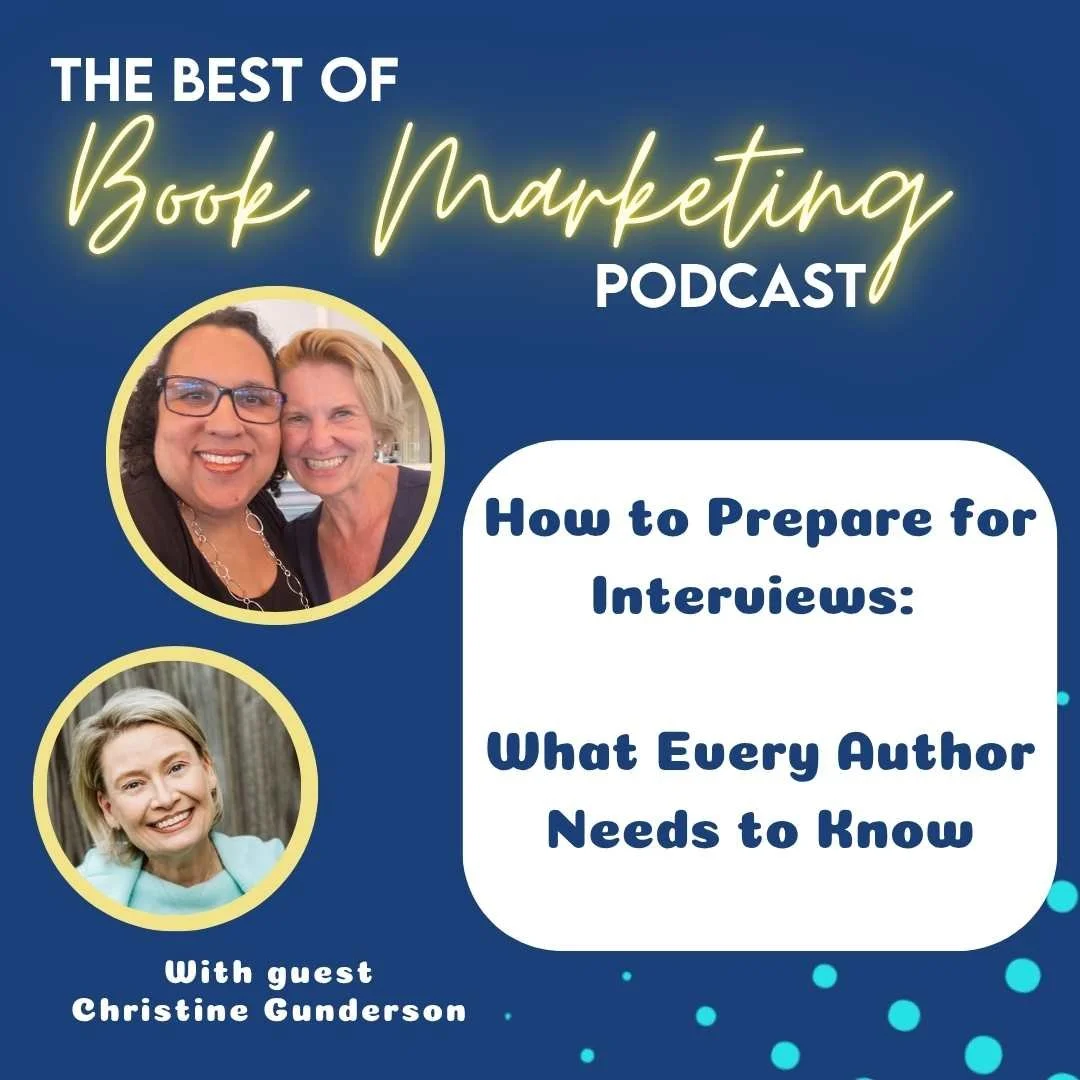


Podcast interviews, virtual book events, social media videos: like it or not, every author will end up on camera to promote their books. And while talking on camera may not come naturally, it's a skill every author can learn.
Christine Gunderson joins us to share how to prepare for interviews! Christine is an Amazon bestselling author, a former TV anchor and reporter, and a former Capitol Hill press secretary and communications director.
In this episode, we cover everything authors need to know to prepare for the interview before hand, and how to navigate the conversation once it starts.
You are the best person to talk about your book. Listen to this episode to learn how to shine when discussing it in an interview.
About Christine Gunderson
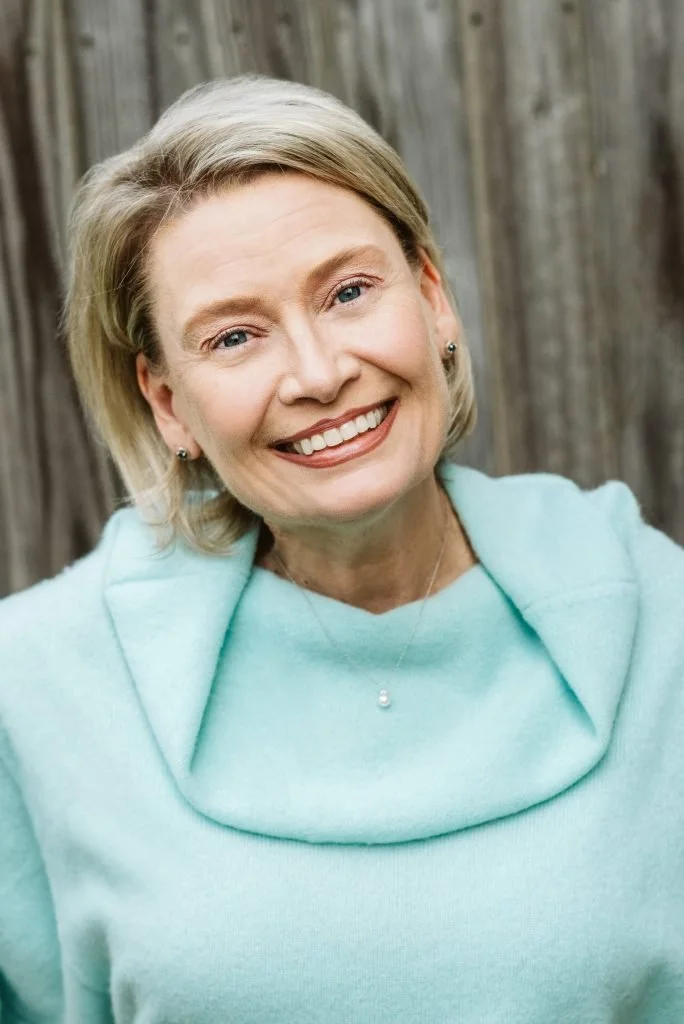
Christine Gunderson grew up on a fourth-generation family farm in rural North Dakota where she read Laura Ingalls Wilder books in her very own little house on the prairie. She’s a former television anchor and reporter and former Capitol Hill aide. She currently lives in the Washington, DC, suburbs with her three children, Star the Wonder Dog, and a very patient husband. When not writing, she’s sailing the Chesapeake Bay with her family, playing Star Wars Monopoly, rereading Jane Austen novels in the school pickup line, or unloading the dishwasher.
Christine loves to hear thoughts and ideas from readers or, best of all, delightful emails telling her she succeeded in making you laugh out loud while reading this book.
Connect with Christine:
Join her newsletter, Notes on Love & Laundry!
Resources
Webcam Lainey mentioned - Logitech Brio 4K webcam (lets you set width of view - 65° diagonal, or 78° or 90°)
Let’s Stop Prying Into the Personal Lives of Women Writers, Shall We? in Marie Claire (2020), by Leah Konen.
Books Mentioned
How to Write a Novel: 49 Rules for Writing a Stupendously Awesome Novel That You Will Love Forever by Nathan Bransford
Brave New You: Strategies, Tools, and Neurohacks to Live More Courageously Every Day by Mary Poffenroth
Full Disclosure: We are part of the Amazon affiliate program, which means Lainey earns a tiny commission (maybe enough for a coffee) if you buy something after clicking through from a link on this website.
Note: next sections are mostly created by AI for your convenience - so please forgive any typos or inaccuracies!
Transcript
Paulette Stout 00:03
Hello, everyone, and welcome to the latest episode of the Best of Book Marketing Podcast. I am Paulette Stout, and we am alongside Lainey Cameron, the incomparable Lainey Cameron, and we are here today to talk to you about how to prepare for on-camera interviews. No matter where you are in your author journey, you will need to be on camera at some point, whether on an interview, on a podcast, doing social media. So you are going to get all the things you need to know today on this episode.
Lainey Cameron 00:33
Well, I'm excited, and in case you're not watching live, I will tell you that I made us late this morning, and we'll actually talk about why when we get into the questions, because there's some beautiful lessons there about preparation for interviews, and I can be our little example today of what not to do.
Lainey Cameron 00:49
So we're a few minutes late starting. Apologies if you were waiting for us, but this is going to be an exciting one. Let's start as usual with our personal updates on what's going on. Do you want to go first, Collette?
Paulette Stout 01:01
Sure. So lately, I've been really focused on writing and coaching and speaking, and you know, working on those presentations. So it's been it's been really rewarding. I you know we've been in this business now for a while, and I just I'm gaining a lot of joy and happiness from giving back to the author community and helping a lot the authors on their journey, so focusing on that a lot. Last Saturday, I participated in the Wide for the Win online conference. Thank you, Lainey, for encouraging me to apply. I was on a panel that was talking about in-person events. The recordings for that event are live or are still available, so it's not too late to get those if you're interested. I'm also be doing a session about to do when your book's not selling at the Independent Publishers of New England conference in February, and that's also virtual, so anyone can attend. So if you get those on your calendars, more to come for 2027, but I'll mention those dates as we get closer. And beyond that, I'm just I'm still trying to plug away my latest book. Finding Time to Write's been a little bit difficult lately, but I'm excited about the characters. About 69,000 words into the draft now, so hopefully I'll have a first draft done soon, and it can start back through it and fixing all the mistakes. What's going on in your world, Lainey?
Lainey Cameron 02:21
I'm also doing some speaking, which is kind of fun. I'm I'm trying to decide when to next offer my 12 Weeks to Book Launch Success class because I've got a lot of other things going on in my life, which is fun and wonderful. Including my big news this week or last week is I'm a brand new grandma, first time grandma. My son and his new wife from just this year had a baby last week, and so I'm heading to Austin to visit them, which I'm very excited about.
Lainey Cameron 02:49
And before that, I'm actually going to Chicago next week. If anyone's in Chicago, hi, come say hi. I'll get coffee with you for a retreat run by my agency that I just joined in June. My new literary agent has an agency out of Chicago, and I'm going to go to their retreat, which I'm really excited about. Meet some of my agency. What do you call it? Siblings, I guess. Other authors who are at your your agency, and I'm also doing quite a bit of speaking. I am going to be let's see, Paulette and I are going to be giving a class for WFWA. Actually, more than a class, a whole marketing incubator accelerator program in January. It's about to be announced, so you heard it here first. I am also teaching at the San Miguel Writers Conference in February.
Lainey Cameron 03:30
I have a three-hour workshop on the Saturday afternoon, all about how to launch your book successfully, which you'll come away with kind of the framework for a launch plan and be ready to start really thinking about your launch. And I'm also talking about AI. I'm on a panel talking about AI at the conference as well. So lots of really fun things coming up. I think that's it for me. I'm so excited to get to our guest. Christine is going to be our first repeat guest on the podcast, which says something about how much we appreciate her. Shall we put her on screen and then we'll do the quick intro.
Paulette Stout 04:00
Absolutely, yes.
Lainey Cameron 04:02
Hey, hey, Christine.
Christine Gunderson 04:05
I am honored to be a repeat guest. Thank you, guys.
Lainey Cameron 04:09
So Christine was on before to talk about what she learned from her debut novel.Right? She will first and second. But this is a whole different topic because this is about how to prepare for interviews. So we can't escape these, right? We have to do them even before our book comes out. Sometimes, if you're going the traditional path, you end up being on Zoom with an agent, or if you're on submission, you might end up on Zoom with an editor who's considering your book. And then, of course, there's all the things when your book is actually coming out, being on podcasts like this that have video, having live interviews, being on social media, on camera, there are so many different times we get asked to speak on camera. And I think we said in the description of this episode, whether we like it or not, it's a bit of the reality of we have to do this. And Christine has this fascinating background where she used to help people on Capitol Hill, and I'll let you. Introduce yourself a bit more, Christine. But she used to help people on Capitol Hill with how to talk on camera, both what to say, how to avoid the awkward questions, and also how to present yourself the right way. And so she's got this wonderful background before becoming an author that she has been helping other authors with this. She actually went and talked to my 12 Weeks to Book Launch Success class several times now, and help them with how to be camera ready. And so we're so excited to have you on, Christine. And maybe just tell us a little bit more about yourself and how you decided to get into helping authors too.
Christine Gunderson 05:31
Well, thank you for having me back. First, you guys are always a joy to chat with.
Christine Gunderson 05:36
Yes, I have kind of an odd background for an author.
Christine Gunderson 05:41
I started out as a television reporter and an anchor at a small ABC affiliate, and I did that for about five years. And then I moved out to Washington D.C. to be a press secretary, and so I was a spokesperson for a couple senators, a House member, two House members, and then I worked in the executive branch, and I was the communications director for a cabinet secretary.
Christine Gunderson 06:06
So I spent a lot of time on the one side of the microphone as a reporter asking people questions, and then I flipped over to the other side of the microphone where I had to answer questions, questions from the press, and then I also had to work with my my members of Congress or my cabinet secretary and help them prepare for debates, help them prepare for the interviews that you editorial board meetings, prepare for campaign events, and prepare for the questions that you get from constituents and from reporters if you're an elected member of Congress. So, I sort of come at this from from both the question side and the answer side, and and also having a background in TV, I've spent an enormous amount of time thinking about my hair and the more the more shallow aspects of the communication process. But it all it all works together, both both what you say and how you look when you say it, and and I find that authors a lot of time our happy place is alone in a room with a cup of coffee and a dog, and and so sometimes for us writing the book is so much easier than talking about the book that we've written, and so that's why I, I like to get out and and share what I learned both the hard way and the easy way in my past life with with authors because obviously I'm an author too, so so that's the the quick and dirty background on on how I got here and and what I know.
Paulette Stout 07:29
So it's so interesting. Can you just share a little bit about what is media training and why? Because I think some people think that people who speak well on camera just show up and it flies and they just have this natural instinct. Can you talk about what media training is and why that's something that authors should invest time in learning?
Christine Gunderson 07:47
Media training is essentially learning how to be your best self on camera. I think that if you're sitting around chatting with your best friend since kindergarten, you're going to be very comfortable. You're probably going to be charming. You're going to be interesting because you're comfortable. And media training is simply learning how to bring your best, most comfortable, most articulate self to settings where you're not as comfortable. Settings where other people are watching, where you're on camera, where there's an audience that you can't see. It's simply finding ways to bring your best self to situations where you might not feel comfortable, and learning learning to anticipate what an interviewer might ask you, learning to anticipate in practice what you say in response to those questions, and then also figuring out how to find a way to look like yourself, but to look like your best self when you're on camera answering those questions.
Lainey Cameron 08:43
So, with everything you've learned, are there some really basics? Like, hey, let's start with get the time right and turn up on time would be a really good basic. I'll tell you what happened this morning. It's very funny. So, so Paulette's messaging me at five minutes past the start time of this interview, and I am standing in my bathrobe, brushing my teeth at the bathroom sink when I see Colette's message and go, "Oh, sugar moly, moly! I really messed this one up. And what happened is we have a two-hour time difference between Eastern and where I am in Mexico at certain times of the year, and then we have a one-hour time difference at different times. And I'm constantly getting confused because it's just confusing to start with, and I normally triple triple check it. I was so tired last night. I was going to bed, and somehow I set my alarm to get up at 730 to be on camera at 735 or 745. So I was absolutely 745 at an hour and 15 minutes, and I was dilly dallying. I was you know wandering around the room, patting the dog, so it's all my fault. But that's probably one of our first ones is triple check the time, set three alarms, and maybe triple triple check the alarms too, and that they are the same as what you put on your calendar. So there you go, all my fault. And if you're ever feeling bad that maybe you made a mistake, there you go. We all do. It's fine. And flip, we're here. We're talking. It's all good. I had a moment of minor heart failure there, but it's all good. So, other than triple check the time and double set your alarm, what are some basics that you wish authors would know about? You know how how to prepare, how to succeed in interviews.
Christine Gunderson 10:18
So there's two two parts of this process, sort of two baskets, if you will. There's the message and there's the messenger. The message is what you say. It's the words that come out of your mouth. It's what you want listeners to take away with them after the interview ends. And then the other basket is the messenger, and it is is the person delivering the message. It's how you look while you are delivering your message, and so if I only had one piece of advice for the message part, which is the the what you are saying, what you want people to remember, for authors it would be to boil your entire book down into one sentence, just one sentence, and you can. Some people call it the logline. Some people call it the elevator pitch. You can call it whatever you want. But my advice would be to boil your book down to one sentence because I can't tell you how many times I've been on panel discussions or podcast interviews with other authors, and the moderator or the host will say, "Well, what's your book about? And authors will go into this extremely long, convoluted, confusing book report about what their book is about. And the result of that is the person listening, they they instead of coming away thinking, "Wow, I really want to read that book. That's interesting. They think that is a confusing mess, and I have no desire to read that book. So you want to boil your book down into one sentence, and I know I know how hard that is because you know we have 400 pages that we have poured our heart and our soul into, and we've spent a year writing and rewriting and editing, and it's really hard to do, but that I think is the single most important thing an author can do when preparing to go out and talk about it. And I have a little formula that I found that works for this. There's a guy named Nathan Bransford, and he wrote a fantastic book called How to Write a Novel, and he came up with this formula that I think is really useful as sort of a starting point to break your book down into a sentence. And it goes like this: It's when opening conflict happens to characters, they must overcome blank conflict to achieve their blank, okay. So when opening conflict happens to characters, they must overcome what kind of conflict to achieve their quest. So basically, you got the character, you got the conflict, you've got the challenge, and you've got what they want to achieve at the end. If you can spend an hour at your desk, just figuring out how to put your book into a one-sentence formula that gives the highlights. I guarantee you're going to feel more confident. You're going to sound more articulate, and everything is going to go better if you just take the time to do that one step. So that's that's my one piece of advice on how to prepare the message part of an on-camera interview,
Paulette Stout 13:25
I absolutely love that. That's a great one, and I've got my own way of thinking, but I'm going to go compare and see if it matches the formula. A couple of things I wanted to add, love to get your thoughts on, is just what are the obvious questions you think you're going to have if you're going into an interview blind and you don't have the questions. Just know the basics. You know what inspired your book. What about your writing process? You know how long have you been writing? What made you start writing? Like just some of those basic things that you anyone would ask you in a normal conversation. Just have good answers to all of those, also that don't ramble for a long time, and then you'll just and you can and the other piece for me is speaking them aloud. I find speaking and practicing the answers out loud it's so much different than just thinking them in your head. Your lips are moving. You've got saliva slushing around. You're dry. You're wet. You're you know just just speak it out loud on a walk, in the shower, in your room. Just get used to moving your mouth and speaking those answers. I find very helpful.
Christine Gunderson 14:28
I find yeah, there are so many great podcasts out there for authors, and I find if you are trying to prepare for something, listen to one of those podcasts, and when the host asks a question, pause your phone, and then answer that question just like you said, Paulette, out loud yourself, and go through a podcast where another author is being interviewed, and pause it every time the host asks a question, and then you answer that question yourself out loud in your own words, because you know there are several standard questions that every author is going. Be asked in every interview, and you just touched on it, Paulette. It's you know what inspired this book. Why did you decide to write this book? What's your writing process? What inspired you? Where do you get your ideas? So so look at the questions other authors are being asked, and then answer them yourself out loud because you're so right, Paulette. It's very different to answer something in your head versus having to use your your mouth to to answer that question out loud. But yeah, listening to other podcasts and answering those same questions yourself is a great way to prepare for what you are more than likely going to be asked yourself in your interview.
Lainey Cameron 15:36
And this is probably a good moment to put a little plug in that last month's episode was all about podcasts, and we got a little bit more into how to specifically prepare for a podcast ideas, like you're saying, of listening to the episode. And I think we mentioned this last month, but I'll add it to what you were saying. Like this one one sentence thing is great, right? Know how to talk about your book, but for goodness sakes, do not rate it off a post-it note on your computer because you look like a robot, and you sound like a robot. So first, you got to do what Christine's saying. You got to be able to describe your book in one sentence. Then you got to walk around the neighborhood, as Paulette said in last month's podcast, and say it out loud again and again and again until it feels like the most natural thing, like ordering your Starbucks order. Do not read it off a post-it note because it's going to make people go like, why doesn't she know how to describe her own book? Like clearly, she's written off a post-it note on the screen, and so yeah, that was that's what I would add to that. Is yes, absolutely, but also learn how to say it.
Christine Gunderson 16:31
Yeah, I think we all, you know, the news this week, you know, the the saga of the White House press secretary who lasted five days, and and one of the things that I think was really instructive about all of that was, you know, going on camera in front of a group of people and reading a statement about you know why you're there. I mean, if something is is a personal expression of this is why I'm here and this is what I hope to accomplish, one would expect that to sort of flow naturally and come from the heart, rather than being haltingly read from a piece of paper in front of you, and so you're right, and it's it's so much more effective when, yeah, it it it is it is something that's coming from your heart, right? It's your book, and so you should be able to talk about it in a natural and articulate way, but most of us can't when we're nervous. Hence, a memorization exercise, right? If you know it's coming, you know what you want to say. Have it down cold, and that is going to give you so much more confidence. I think sometimes people think, well, isn't it sort of artificial, you know, to rehearse this and practice this over and over? Don't I want it be to be spontaneous? You're going to have so much more confidence if you know what you're going to say, and you feel confident about how you're going to say it, and that's where the preparation component comes in. And I think preparation leads to confidence, and confidence is what you want to project. It's your book. You wrote it. You wrote a book. Be confident about being out in the world talking about this incredible thing that you created. Be confident because it's it's a huge accomplishment.
Paulette Stout 18:04
I love this, and one thing that you'll probably notice that how Christine is answering her questions, and also how Lainey and I engage is we pause to let the other person speak. So make sure that as you're practicing your answers, you're planning for it to be a conversation, and we have time for the host to speak. We've we've run into that a few times on the show where people don't pause long enough, which is a good transition into like you've obviously worked with the media for so long. You've been in all those situations. Can you share a little bit about how you've learned how to handle interviews that start going badly? You know what what should ah how can authors recover from that?
Christine Gunderson 18:42
You know, being a press secretary is fantastic, fantastic practice in how to handle interviews that go wrong. Because when you're working in politics or government, you know a lot of the reporters are not there to to make you feel better and to give you a positive experience. They're there to get to the truth. They're there to find the answers. And so, I think the best way to handle an interview that's sort of going off the rails is to try and remember why you were there in the first place. Why did you go on that podcast? What is the one thing that you want people to remember, and then try and always bring it back to that one thing. And so, you know, most author interviews, fortunately, are are not going to be hostile. They're not going to be asking trick questions. They're not going to be trying to to make you feel uncomfortable. I'm going to try and make you comfortable. But I'm just trying to anticipate something that could perhaps be a little bit controversial. Like maybe it's AI, right? People have different views on AI. I personally would never ever use AI for any part of the writing process. But maybe someone's pushing back. Maybe someone thinks it's okay to use AI. Think about a way to express your view respectfully, and then to always get the topic back onto. The topic that you came onto the interview to discuss, and you know, as a press secretary, we always said they can ask you any question you they want, and you can answer any question you want. And I think we've all seen this with politicians. Someone will say, "Why did you embezzle the money? Well, what I'm really here to talk about is you know what I want to do for the hardworking American people, and that can be frustrating, but also there is an art to that, right? Like if someone asks you some kind of controversial question and you just don't want to go there, you don't have to go there. You can deflect. You can say, "Wow, that's a really interesting question. But what I'm here to talk about today is my fabulous book, and this is what it's about. You can deflect, you can redirect, and you can go back to your reason for doing that interview in the first place.
Lainey Cameron 20:43
I think that's brilliant advice. I had a little bit of that with my first book, in that there were some topics I didn't want to go into, and it was things relative to my personal life that I didn't think were relevant. Like I wrote a book, I'm happy to talk about it. It's fiction, but I'm not going to talk about some things relative to my personal life, and so I was ready with the alternate that I wanted to talk about. So I wanted to talk about sexism in Silicon Valley, and I did very much what you're saying. It actually never became an issue. I was much more worried about it in my head than the reality, which is another thing I see is like with author interviews. Generally, you know, we're not running for president. No one's trying to like find out whether or not we're going to be on the ticket. It's not quite that dramatic, although I do love that politicians have like 100 different ways to not answer that question. It's fascinating, but like for me, I was I was doing exactly what you said-the pivot of well, you know what I really want to talk about is sexism in Silicon Valley. It's still an issue today, and I'm off talking about that, and it worked out fine. Like like mostly, what was helpful was knowing in my head what I would be willing to talk about. Sort of, sort of, if the big scary thing that I didn't want to talk about came up, I knew what I was going to transition or pivot to or talk about instead, and I didn't have any worries that I, you know, was doing something bad by not answering the question. There was a wonderful interview, actually a a piece that one of the writers wrote during-I'll find it if I can and put it in the show notes in the on the website episode page. But it was about how women get asked more personal questions when they come out with fiction than men than men, right? When a guy writes a sci-fi novel, no one says, you know, was The Martian inspired by your real life of being trapped in a thing in space, right? Like, like even if it was a real life novel, nobody asks those questions. But women write about you know domestic abuse, and very often get asked on camera, "Is this something you have personally survived? And it's not okay, right? If someone wrote fiction, in my personal opinion, it's not okay, and they have no freaking business asking that question. But you may be asked, and so knowing how to get out of that conversation, and that it's perfectly fine to not answer the question. Like we give you permission; you don't have to answer questions that are invasive or not something that's on message or not something you want to be on record talking about.
Christine Gunderson 22:55
Yeah, and that's a great point to to think about that in advance and think about where's my line. You know how much how much of my my life do I want to reveal? And as an author, I think a lot of times people assume, I think people who don't have the crazy vivid imaginations that we have assume that when we write something, it's because we've experienced it. And sometimes we have, but a lot of times we have this incredible superpower where we can put ourselves in someone else's shoes and imagine what it is like to feel something that we have never experienced. And I think for non-writers, they have a hard time understanding that. And so I do think we tend to get a lot of questions about, well, you wrote about that. Clearly, you must have some experience with it. And it's like, well, no, actually, I'm just an empathetic person who does a lot of research. So I think you're right, and we we don't have to go to places we don't want to go to. But if you know where the line is and you think about it in advance, it's much easier to sort of hold the line and redirect, like you did, Lainey, and do it in a way that is is conversational and is respectful, but it also sort of holds the line of of why you're there and what you want to talk about,
Lainey Cameron 24:02
have you ever written off an interview? I talked to somebody recently who said they got into an interview, and it was actually Paulette. Maybe it was last month's episode. You said one that it went very badly, and like halfway through, you said to yourself, "I'm never promoting this. Like, it's hopefully just going to die out there somewhere. Maybe it never even get published. Like, have you got any like? Let's talk about that a little bit. It's kind of an interesting idea of like you you get in and like the I have seen these interviews actually even in author land where maybe the post just loves to talk and they're just off talking about things that are not vaguely relevant to your book and they're off talking about I don't know their new grandkid and it's just like you're like do I do I try and pull this back? Do I try and fix this? Like, I'd love to talk about that a little bit.
Christine Gunderson 24:45
I think that
Christine Gunderson 24:47
you know, if it's a good podcast host, like you guys obviously are, they know how to keep an interview on track, and they're there for the right reasons, which is to help readers get to know this new author. And if they're just there to sort of talk about.
Christine Gunderson 25:25
even if the conversation was wide ranging, it always sort of came back to the core reason for being on there, which was discussing motherhood in my case with my last book. So I haven't had that experience, but I think the way Paulette handled it was probably very graceful, which is to sort of be okay. I'm here. I'm gonna go with it, but I'm never gonna be on this podcast again, and I am not going to promote this. I mean, she she certainly didn't embarrass anyone. You you didn't say, "Wow, you're a really bad interviewer. You just sort of went with it in a graceful and gracious way, and then you're like, "Okay, I'm not doing that again. And I think that's. I thought it's so hard, though, Christine. I was like, "You are a boob. I'm an author who writes books, and you are obviously not prepared for this interview. And thank goodness the episode never aired because I was not going to be posting that on my social channels anywhere, not promoting this host.
Paulette Stout 26:16
But yeah, go ahead, Lainey. Well, I think also,
Christine Gunderson 26:20
well, the camera's always watching, right? So it's you're kind of limited in what you can do because it's it's on camera, and so I think what you did, where you just sort of, you know, what's that what's that term, gray rocking, where you just sort of like you were there, you went with it, you didn't say say out loud what you were thinking. I think that's that's a really, I think that is a perfect way to handle a situation like that.
Paulette Stout 26:44
That's
Lainey Cameron 26:44
hard for me, like not to let my face show. Like I think you're a complete idiot. You've tried really hard just
Christine Gunderson 26:49
to smell. Or wow, that's a really interesting question. Yeah, so hard. Interesting question.
Paulette Stout 26:58
He had a pre-interview. I'm not saying he. I'm sorry. It was a there was a pre-interview before the interview. It was just a disaster. But let's let's get back to our interview question. Okay,
Lainey Cameron 27:10
so why don't we go to the second part of what Christine was talking about, which is the messenger. So you said it's the message and the messenger, and we talked about the message, which is what you're going to say on camera. But the messenger is how you come across saying it. The look, everything. Can we talk a little bit more about that? Tell tell me why it matters so much.
Christine Gunderson 27:30
You know, I feel like the message part is the most important part, right? But I feel like the messenger part, the how you look part, is the part that freaks people out the most and gives people the most anxiety, so it's the least important part. But I think it is the most anxiety-inducing part, and I think part of it is just you know you're very vulnerable when you go out on camera. You are sort of putting yourself out there. You feel like people are going to judge how you look, they're going to judge what you say, they're going to judge how you sound, and so I think the antidote to that sort of vulnerability of being on camera is to prepare. Once again, the antidote to all of this is preparation. And so, the first thing I would recommend is going upstairs into your closet. Look at all your clothes. Just look at all your clothes. Stand back, and you're going to notice that there's probably one color in your closet that is predominant. There's a color that you tend to buy more often. You tend to wear more often, and it's probably because that's a color that looks really nice on you. It's a color that people have told you, "Wow, you look really nice today. It's a color that you buy a lot because it's a color you feel confident in. So look at your closet, find your color, the color that you wear more often, and that's going to be your starting point. And then look at your wardrobe again and figure out what do I wear a lot. And so, not not what you wear when you're writing necessarily, because when I'm writing, I tend to wear pajamas and a sweater with a stain on it. So that's that's not what we want to wear when we're on camera. But if you were going to a job interview, or if you were going to dress up nicely for a nice out to dinner, night out to dinner, what would you wear when you want to look nice? You want to look professional. Do you wear a button-down shirt? Is that what is comfortable to you? Do you wear a sweater? Do you wear a blazer? I spent years in blazers. I wore a suit every day when I was a reporter. I wore a suit every day on the Hill. I am wearing a blazer today because I feel comfortable and confident in a blazer because that was my uniform for so many years. I I don't feel comfortable wearing something less formal than this, so I go with it. So, do I need to wear a blazer to do this podcast on a Saturday morning? Maybe not, but but this is this gives me confidence. A blazer gives me confidence. So, figure out what do you feel confident in, because that's the most important thing. Wearing something that you feel comfortable and comfortable. Confident in. Once you've got that, that's your uniform. You pick one outfit that you really love. You feel confident in, and you wear that for all your interviews. You're like you're like Steve Jobs, right? He had this uniform that he wore. He wore a black turtleneck and jeans. So find your Steve Jobs uniform, and then you don't have to reinvent the wheel every time you have to do a podcast, and then there's just a couple practical considerations, which is don't wear lines. I would not recommend wild prints. I would recommend a solid color. Don't wear oh oh that's rightful. But you, it's great. It's I'm talking about fine lines, like really fine lines, because they they can go sort of electric, but just generally speaking, a solid color that you feel comfortable in. It doesn't doesn't matter what color it is, but a solid color, wild prints like wild florals are probably not a good idea. Distracting crazy jewelry is not a good idea. You don't want anyone looking at you, thinking, is that an elephant on her shirt? Is it a palm tree? With those earrings, what what are what is that? Is that a palm tree on her?
Christine Gunderson 31:09
You you don't want anyone looking at you, trying to figure out what you're wearing. You just want you want your appearance to be sort of a pleasant backdrop, so that the words are all that you want. The words coming out of your mouth to be center stage, and your appearance is a sort of pleasant backdrop that allows the words to shine. That's where you want the focus, the words, the message, not the messenger. If that makes sense,
Paulette Stout 31:37
totally makes sense. I love that. One thing, it's funny because for me, my favorite happy color is black. I wear a lot of black over the years. I've definitely been incorporating more color into my palette, but I also have dark hair. So what I try to do on camera too is wear something that's going to contrast, so that my hair color doesn't just blend into my clothing, and then on camera, it gives like a little bit of a disjointed, creepy appearance because you can't quite tell where my body starts or my clothing ends. You know, like that whole thing. So that's something I do selfishly. I like we use these videos to promote social on social media. I like to wear bright colors and things that are bold. So maybe when you're scrolling in your feed, you know, you have that, so I wouldn't wear a horizontal striped shirt like I'm wearing right now. For those who are watching on video, usually to an interview, there's ulterior motive for me wearing stripes sometimes.
Lainey Cameron 32:33
Yeah, I think I think you're right, Paulette. Thinking about your coloring, so like Christine and I are both blonde and fairly pale, and I can also wear blue, and it works for me, just like Christina. You look great, by the way, Christine. I just want to say you look fabulous, fabulous. But but like for me, if I wear a pale color, so if I wore like a pale lemon or a white, I would just fade into the background. I would just look like a ghost. Like literally, you wouldn't be able to see my facial features. And so like being aware of how you're coloring, whether you're dark, whether you're light, like just being aware of how that affects what you wear and what colors do well on you and what colors make you kind of disappear is very important, right? Like like Paulette says, you've got dark hair, so if you wear dark top, you end up with a floating face, right? Like it sounds silly, but like try it on Zoom. Go go create a free, just spin up a free Zoom and look at yourself on camera. Like it's not that hard. Nobody else needs to be there, and it just helps because you can see it sometimes. It's it's weird, right? Like looking at yourself
Christine Gunderson 33:30
in the mirror is not the same as looking at yourself on camera. No, it's not, and it's um, and that also brings us to the other part of the messenger, which is your backdrop. Um, you know, I was on a I was on some kind of a workshop, and the workshop presenter was wonderful, but I did not hear of half of what she said because she had this strange thing on this bookshelf behind her, and it was kind of like a helmet. And I'm like, is that a World War II helmet? Is that like what is that? And the entire time she was speaking, I was distracted by my brain wanted to figure out and identify that what I was looking at, and so think about what is behind you because that is part of the presentation, right? That is your your background can either enhance or it can distract, and so and it's also part of your uniform. So every single time I do anything on camera, this is the backdrop I've got. So I've got I've got my books. I shamelessly put my books right there so that people can see them because I want people to to recognize the covers of my books. And I also try to I try to make it pleasant. This is my office where I work, and so I just I do the same thing every time. I set my books up behind me. I clear off this table that is normally covered with papers and is a mess, and this is what I use. So find a backdrop that has some kind of dimension to it, that has sort of a background. I use a Zoom platform, or I use a. Platform for my laptop, and so I have it's raised up a little bit, so so I have some depth behind me, and then I just clear off the table so that there aren't a lot of distractions. There's not a lot of clutter. I try and make my book sort of front and center in that backdrop, but again, I don't want you to pay attention to my backdrop. I want you to think it's sort of pleasant, it's sort of there, but it is it is the backdrop to the words coming out of my mouth, and that's that's the other thing. Again, it should be pleasant, it should be uncluttered, but it should be a backdrop.
Lainey Cameron 35:30
And how do you feel about Zoom backgrounds? Like very often now, people are doing interviews, maybe in a house that has kids running around, or dogs, or or disruption, and they're trying to use a Zoom background to keep all that out of the picture. Is that okay?
Christine Gunderson 35:44
I think that's great. If the alternative is yes, wild, insane chaos behind you, but I also think that if you use, and I also think it should look realistic. I know one author who uses a Zoom backdrop, but if she moves, you know. It. She looks like a disembodied creature, like a ghost. And so, you you want to be aware of the technical limitations of using a zoom background. But I do feel like if you if you can, if you have the space, if you have the opportunity, you can project something about who you are. You can give people insights into your personality and who you are, if you're sitting in a real room with real things behind you, and you know, I once did media training with an author who'd written something like 28 books, and her backdrop was just a blank wall. And I'm like, you have accomplished this incredible thing. You've written 28 books. Why are we not seeing those 28 books behind you. This is this is credibility. This is showing people your your your bona fides as an author. You know, if you have something that enhances the message, then then put that out there. If you've written 28 books, have those 28 books behind you because that is is a part of your accomplishments as an author, so so show that. So I would say a Zoom backdrop. If if the background is going to be chaos, hide it. That's great. But if you have the opportunity to show people a little bit more about yourself and about your personality with your backdrop, then I I think that's I think you should do that.
Lainey Cameron 37:18
I have a little tip here on
Paulette Stout 37:19
the. Go ahead. Go ahead.
Lainey Cameron 37:20
I have a little tip here on the the camera angle. If you are in a house that has a lot of like things going on and clutter, and it's hard to find a beautiful space like Christine is showing us, I have massive office envy for Christine's office behind you. But my friend, my good friend Mary Puffin Ruff, who's a doctor and talks about fear and how to overcome fear. If you're actually interested in how to overcome fear for your presentations, I recommend her book, which Top Secret actually has me in it in some of the stories in my old name before I was Lainey. But but one of the things she gave me as a tip, which is brilliant, when I was a nomad and I was traveling around and I was podcasting, but every time I was in a different Airbnb, and so I could never like be sure of what the environment and the background was going to look like. The camera that I use-it's a Logitech Brio. I'm sure there's other cameras that do this, but this one in particular has software where you can even widen or narrow the field of vision on the camera, so you can make it so that you can literally stand, you know, in a corner of a room, and it'll only show just that corner, not the wide angle that has, you know, the laundry machine and the dishwasher in the kitchen. And so that's actually really helpful if you don't have control of your environment and you're maybe moving around to get a camera that has software that lets you narrow the field of vision, so it's not a big white angle.
Christine Gunderson 38:42
Yeah, that's that's brilliant because again, you're right. What if you're traveling? You know, what if you're in a hotel room? You don't want the bed in the backdrop, probably, right? So so figure it can be very
Lainey Cameron 38:51
hard in a hotel room to get the bed out of the frame.
Christine Gunderson 38:54
Exactly. So yes, so that's a great that's a great example of you know. But also, as you said, Lainey, you know, looking in advance, you know, going on Zoom just just for three minutes to take a look at okay, what does this look like behind me? Because it's really difficult to figure that out unless you unless you set up a shot basically to see what's going to be behind you when you're doing the interview.
Lainey Cameron 39:16
There there are the famous scenes of like, do you remember during COVID when everybody was on camera, and there would be like famous scenes of where someone hadn't looked in their background, and there was like a vibrator sitting on the table or something. So like, do look at your background if you're moving around and you're not always in the same place. Check what's in the background. I'm often running around hotel rooms, moving things out of the way when I realize they're in a shot. Yeah,
Christine Gunderson 39:38
I mean, yeah, and the only way to do that, as you said, is to is to check on camera, like
Lainey Cameron 39:42
the coffee machine. You wouldn't think about it, but it can be incredibly distracting to have one of those like Nespresso machines in the background, and it's got the pods, and they're shiny, and they're shining on camera. Just look if you're in a in a new environment. Just look at the background. Yeah,
Christine Gunderson 39:56
yeah,
Paulette Stout 39:57
that's a good transition to a question. In terms of, we talked about distractions with the helmet and so forth, but there's sometimes there's things we wear that can also be distracting. I wear glasses, and those reflect if you have a you know different prosthetic or different devices that might reflect you know camera lights. Do you have any tips for folks who are you know what you're wearing and how that potentially engages with the camera with reflections and things?
Christine Gunderson 40:21
I wear glasses too, and so and I've tried different, you know, those ring ring lights and things like that, and they do tend to reflect in your glasses. So what I've started doing is I just rely on the overhead lights here in my office. I've got a big window in front of me, and that lets in a lot of natural light. So I turn on as many other forms of light as I can, so that I don't have to rely on lights that will reflect in my glasses. But that's another thing. If you you know set up the shot, look at it on Zoom, and and you'll notice. Oh my gosh, I've got you know little little lights right here that's reflected. So just I would say check that out, and you can also you can you know raise it, you can lower it, you can put it over the side, you can do different things to eliminate that. But that is absolutely something to check out because that is unfortunately distracting to the reader, right? If every time I'm moving my head, you see these little pinpoints of light going around, that's going to distract from the message, from the words coming out of my mouth, from my whole reason for going on the podcast, so it sounds like a minor thing, but anything that's going to distract people and prevent them from hearing your words is something you want to eliminate if you can.
Paulette Stout 41:33
So that's a great point. I I had to move away from a living light for that exact reason because I do wear glasses and I have a light that has a diffuser over it, so you don't have a central point of focus for the light. I've also sometimes tilt. I just tilt them a little skew on my face, so it rotates the the angle of the lens, so it's not reflecting straight. It's it's it makes it so you can see my eyes through the lens versus the glass reflecting, so just be aware of that. I've tried powdering them. I've tried all doing all. I've tried leaving them dirty for interviews, so they're not like super clean right when the camera starts. So experiment with what works for you with the lighting that Christine suggested. Tilting your glasses, doing different things, angles, diffusers. Some of those things could be helpful if you have glasses or something shiny that you have to wear.
Lainey Cameron 42:23
Yeah, can we talk about makeup? So I know this is a bit of a controversial topic because I think many women would say, "What? I have to go get all pretty for camera. But I liked how you talked about makeup when you came to my class, Christine, and you you were saying it's less about looking pretty on camera and more about...
Christine Gunderson 42:42
Well, like I said again about what do you want them to be focusing on? Do you like like Lainey pointed out? We're both blonde and pale, so if I came on this camera with no makeup on at all, you would be like, "Oh my goodness, is she ill? Why is that woman so pale? Is she about to pass out? Like what what is wrong with her? You and that would be distracting from my message, right? The goal is always to keep keep the focus on the message, not on the messenger. And so I wear makeup so that I have some color, so that I don't look like I'm about to pass out because I'm so pale. And also, makeup can emphasize certain features that help you communicate. I am a football mom and a crew mom and a theater mom, and so I help out with shows a lot. I'm one of the makeup moms when my daughter does her high school performances. And show makeup, they really emphasize the eyes, right? Because it helps to express. It helps with facial expression, right? And so makeup, basically, it it helps us to express the message that we're trying to deliver. So I would recommend at least just a little foundation, maybe a little blush, a little color. You don't need to go crazy, you don't need to do anything you're uncomfortable with. But again, if you're going to go on camera with no makeup on at all, it's going to be more difficult for people watching to to see your expressions, and it also they might be distracted by how pale you are. You might sort of fade into the background. Your face isn't going to have any dimension. So I would say just a little bit of powder or foundation, a little bit of blush to give you some color, and maybe you know some mascara to make your eyes pop. Those are things that are going to again make people more focused on the message that you're delivering instead of making them wonder why why you look so pale and if you have low blood sugar and are you about to pass out? So, it's it's a communication tool. It's not like you said, Lainey. It's not about you know being pretty. It's it's about again putting the focus on the message and not on you as a messenger.
Paulette Stout 44:55
This is my first point of minor disagreement with our awesome guest. Is I feel like there's an aspect in our current media landscape that really values authenticity and like showing up like who you are as you are consistently. So for me, if if Lainey showed up with makeup, I would wonder what was going on. Is it like is it deal to small deal to most birthdays or something? You know, because that's just not like who she is, so I think there's an aspect of authenticity that still needs to kind of play into those decisions a little bit. Because you know, I didn't start wearing makeup until I was in my mid 40s, and before then, I was like, "You got what you got.
Lainey Cameron 45:35
Okay, so so this is interesting because I am wearing makeup. So without makeup, it's exactly what Christine was saying. So without makeup, I look really pale. I'm wearing blush and I'm wearing eyeliner, eyeshadow. No, what do you call it? Eyebrow. I darken my eyebrows and I put on a little bit of blush. But yeah, you you look at me on camera. I don't look like I'm wearing makeup, but it's just enough that you can see my expression without thinking I'm wearing makeup, so it's a really good example. If I didn't do that, I would. I keep saying pale, which makes us sound really like we think everybody is white. So I just want to point out that we don't think everybody is white.
Paulette Stout 46:10
I noticed y'all doing that. Yes. Yeah.
Lainey Cameron 46:13
Yeah. Like, please less like please some
Paulette Stout 46:16
White centered.Yes. Yeah,
Lainey Cameron 46:17
We're very white centered on the makeup thing. So grant us some grace on that, but I happen to have that life experience of being very pale. That's just my life experience. But I actually do put on a little bit of makeup because otherwise you don't see my expression, and so I put a little bit of eyebrow and a little bit of blush and not much. And I love that you think I'm not wearing makeup because that's the goal, right? I don't want to like I don't wear a lot of makeup. And in real life, I often don't wear makeup at all because you're standing next to me and you can't you you don't need that to see my expression. I do wish we had someone here who could give us tips for people of color because I feel like this has been very weight centric. But I don't have any good advice. Give me tips.
Paulette Stout 46:54
I'm a person of color. Yeah, go good.
Lainey Cameron 46:57
Do you have any good tips for us?
Paulette Stout 46:57
Yeah, I mean for me, it's it's about wearing what you're comfortable with and finding, you know, tones that blend in with your natural skin tone. Can be, you know, I started using powder foundation because I found that the liquids sometimes were that didn't match really well, and I could blend it better with powders. But there's all kinds of different. You can blend different foundation colors to match your skin tone, if you can't find one that matches your color, so but I think people, I did want to also just clarify one point. Yes, I am on camera a lot all over social media with zero makeup and looking like all kinds of ugly, but for an interview, I do take that extra effort, and I don't know that I would ever turn up to an interview without makeup on. So yeah. So yeah.
Christine Gunderson 47:44
And that's you know if you yeah and if you do you know I used to do many years ago talking head stuff where you know CNN would call and they would want you to do a three minute hit on something and they would send a black town car for you with a bottle of water and they'd pick you up and it was wonderful, and you know, if you see someone, an expert, doing something on CNN, a lot of times they are putting makeup on them, like men. You know, they will they will put men in the makeup chair, they will put pancake makeup on them, and then they will send them out on TV. So again, I yeah, it's not it's not about looking pretty. It's more about not not being distracting, like you know, Lainey wearing makeup that we don't know that she's wearing makeup, so that you know she has eyebrows, so we can we can see the eyebrows moving and we know what she's expressing. And I do think you're absolutely right, Paulette. It can also be a distraction if if it isn't authentic. I think we've all seen people out there with the lip bumper and the Botox and and that I think you know that damages credibility. I think if there is is so much artificiality and it's clear that all of the emphasis is on the appearance and there is no no emphasis on the substance. I think that can also be really counterproductive if it's overdone, I think again the whole point of the backdrop and the way we dress and how we look is to, for us, for our appearance to recede into the background, so that the message and the words can take center stage and be front and center. It's always sort of diminishing our appearance, so that the words are the thing that people are focusing on, and oddly, ironically, makeup can sometimes help our appearance to sort of diminish a little bit more, so that the words can take center stage.
Lainey Cameron 49:31
So I'm going to skip ahead because I feel like we we had some questions here around the content, but I feel like you covered that really well already. But maybe let's get into what to do about nerves? Because the reality is, right? You might get on the interview, you've practiced, and then like you just like you stumble, right? Like, what do you do if you stumble?
Christine Gunderson 49:52
You keep going. You just keep going. I think it will feel like you have, you know, made this jump. Blurby mistake, but you know the people listening-they might be listening to this podcast while they're walking their dog, while they're unloading the dishwasher. They're listening and they're doing something else. It's not going to be nearly as obvious to them as it's going to be to you. And again, now if you say something incorrect, you know if you give out some statistic and it's wrong. I think you have an obligation to go back and say, "Gar, I misspoke. It's actually 400,000, not 200,000. But if it's just you going, just just just keep going, just keep going, and it's not nearly as obvious, I think, to other people as it is to you. And if you you know draw attention to it and say, "Oh gosh, I'm sorry for my three second blah blah blah blah blah blah blah. You know, you're just you're like piling piling a flag on top of the mistake that you've already made. But everybody misspeaks. I've misspoken 50 times since we've done this interview. It's it's human, and I think Paula, you made such a great point about authenticity, right? You know, no one is expecting us to be polished public speakers. We're writers. We're there to talk about our books. And so, if we stumble or we make a few mistakes or we're not 100% polished, I don't think anyone's expecting that of us. I think they're just expecting us to come on there and hopefully be a pleasant, normal person who who wrote an interesting book. I think that's that's what people are expecting, and I don't think I don't think anyone's expecting us to be perfect. At least I hope they're not. But I I don't think that's the expectation. And I love what you said about authenticity, Paulette, because I think making a few mistakes is human, and and people are human.
Paulette Stout 51:37
Yeah, one thing I've noticed my very first on a recorded interview was a radio interview, and I hardly slept that night before, and I was really way more agitated and unfocused, and I couldn't remember my preparation because I hadn't slept well. So, I and that was something I did to myself because I was just staying up like doing something goofy. You know, it wasn't like I was up like thinking about the interview and I couldn't sleep. So I highly recommend, especially if you're not as experienced doing on camera interviews, is really try to sleep well the few nights before. Because even if you don't sleep fantastically the night before the interview, at least you'll have a little bit of store of some rest before them. Because that's going to help you think clearly. That's going to help you remember your answers. Be more articulate. If you haven't slept, you're going to not be your best self. So you may even have like bags under your eyes or whatever. So I really highly recommend you sleep. Have some water nearby in case you kind of stutter or or cough or something. So just try to put yourself in the best position to be successful and make all that preparation count.
Lainey Cameron 52:47
And even sleep might confuse the time of the interview and turn up an hour late too. I would even say
Christine Gunderson 52:54
that if you're like, let's say you're stuck in traffic and you're gonna you're gonna roll in for this interview, sweaty and flustered, and I would say it would be better to reschedule the interview than to do an interview where you know you're just not you're just not ready. I would say it would almost be better to reschedule in in a situation like that where you're you're sweaty, you're flustered, you're, you're just you're you're going to be no matter how hard you try. You know you are not going to be at your best. I think it would be better to reschedule than to go out there and do a bad job and know that it's out there and know that you had this opportunity to talk about your book and you failed to do that just because traffic or something else got in the way, and you're out there sort of floundering on camera. I think it'd be better not to do the interview than to do it in a way that is not showing the world your best self.
Lainey Cameron 53:58
And we've talked a few a few times about practice, but is there anything in particular you recommend in terms of a practice routine, Christine?
Christine Gunderson 54:06
I would say again. I think it was Paulette who mentioned even if you can just get a free Zoom account, I would recommend practicing on Zoom, and or I would recommend setting up your camera on your phone and Recording it, so so you know have a list of questions, answer those questions out loud on camera on your phone, record it, and then play it back and watch. And it's hard to do. I don't think anyone, except perhaps narcissists or supermodels, enjoy looking at themselves on camera. But that's what I would recommend doing: is practice on camera, practice the words that you've heard other authors or the questions other authors have answered in podcasts, and and then play it back and watch yourself. I once saw an interview with Kate Middleton very early on in her her tenure as a member of the royal family, and she's so. Beautiful, so kind, so articulate. But she had this habit early on. She has this long, beautiful hair, where she she would go like this. So over and over in the course of an interview, it was almost like a tick. She would go like this, and so for
Lainey Cameron 55:13
those who are hearing us on audio, Christine is flicking her hair, flicking
Christine Gunderson 55:17
my hair, and she doesn't do that anymore. And so I I think that that is something where if you're practicing on camera, you we all have these little things that we do, right? You might have this weird expression, you might blink, you might you might do this this odd thing that you're not aware of. But if you're practicing on camera, you can see it all, and you could be like, "Gosh, I keep every three seconds I flick my hair. Maybe I need to like press my hand down when I'm doing this so that I resist the urge to do that. But I think if you practice on camera, you're going to see the good, the bad, the warts, the ticks, and that's going to help you get rid of them. Because again, there's nothing wrong with flicking your hair every three minutes, but it distracts from your message. And the point is always to have people hearing the message, not thinking about flicking your hair, not thinking about what you're wearing, not thinking about your makeup, thinking about what you're saying.
Paulette Stout 56:08
So two little things I just wanted to add on to that. Those that's all fantastic. Is I used to I used to nod a lot when I was on camera, and if it's like too much and it's distracting, so I have to be very careful not to because everyone says such amazing things on this show that I want to agree with, but I have to be careful of my nodding. So it's also when you're not speaking, you need to also be careful of kind of what you're doing if you're on camera. And if for some reason you're in a situation where you're standing and on camera, then your whole body is in play, right? You know, I have I've worked with executives who have very kind of demure body language, where they wrap themselves and they make themselves smaller, like cross legs or things like that. And those are all communicating potential lack of confidence and how you're you're using the rest of your body. We're not going to cover that today. Just wanted to touch that a little bit because how you use your whole body kind of impacts sometimes posture. Some people like to stand, even though you're only seeing shoulders and head on these things. Some people like to stand because it makes them feel more confident off camera. So just a couple little things.
Lainey Cameron 57:17
I have one that I used to. I'm an ex tech executive, so I used to do presentations for really big rooms, like 1000s of people, and I would spin my rings on my finger, and I wouldn't do when I was sitting, but when I'm standing, and it's like especially when you've got like a town hall forum Q and A, and sometimes people are asking questions, and the question takes a long time, and I would stand there and spin my rings on my finger, and I eventually realized the only way I was going to stop that was to not wear my rings, and I would take them off and put them away before I gave a presentation because I just wasn't able to not to stop myself from doing that.
Christine Gunderson 57:51
That's a that is a great example of something that you it's not obvious to you that you're doing it, and then you realized it, and yeah, and and you figured out the only way to prevent that is just to take them off. That that's a great example of one of those weird things that we all do. Something like that is figuring out what's your weird thing and then finding a way to prevent it. Yeah, yeah, and it made
Lainey Cameron 58:10
me look nervous, and that was the problem because it made me like I was nervous and I wasn't confident in what I was saying or being in the firm. And when you're an executive, it's very important to you know to to seem confident.
Christine Gunderson 58:22
Yeah, and also too, there are also environmental things. And I I did so many podcasts when the last book came out, and still there were things I forgot and I screwed up. Like I have an Alexa right here on my desk, and I forgot to turn unplug my Alexa, and so my kids are like, "Mom, it's time to eat dinner, and I'm like, "Oh my gosh, you know, or I have this dog, this terrible little dog who barks at everything, and she she lives in my office here with me. And once I forgot to go and put her upstairs in her crate, and so the Amazon man came and so I mean, none of us do this perfectly. It's it's just you know, so you can't think of everything, but think of as many things as you can and try to mitigate for for those distractions as much as you can. But I mean, we don't do this for a living, right? We write books for a living. Like this is we write books for a living, and this is an extra thing that is now expected of us as authors. We do the best that we can, but we're never going to do it perfectly. And again, I don't think anyone is expecting us to be perfect. We are not talk show hosts; we are writers, and so we we need to be great writers. We don't need to be great talk show hosts. We just need to be good enough that hopefully people will think our book is compelling and and go out and buy it.
Paulette Stout 59:40
Well, you have been the most delightful guest. This has been an amazing. We didn't follow any of our questions hardly because it just flowed so beautifully. You could tell you've done this before. Thank you so much for joining us. Can you just tell us a little bit more about how listeners can support you, find you, learn about you, and any other services you offer?
Christine Gunderson 59:59
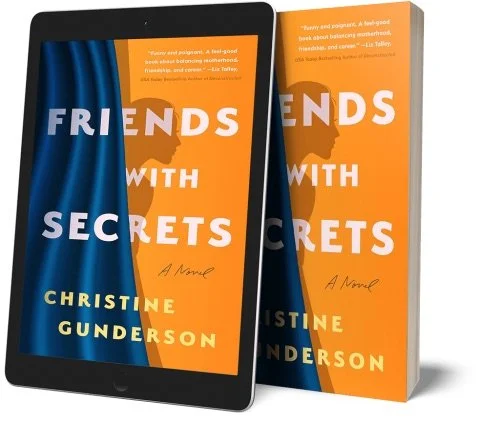
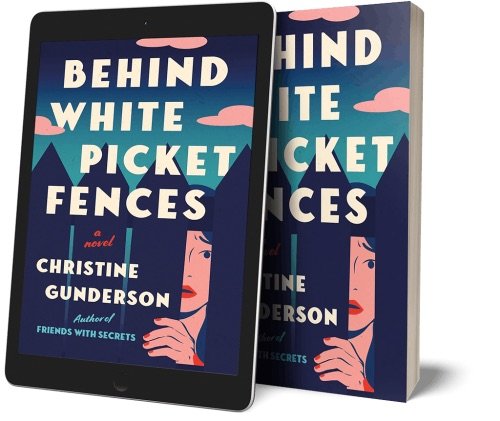
The best way listeners can support me, and I would be deeply grateful if they would buy my books. This is Friends with Secrets. It was an Amazon bestseller. You can get this one on Amazon, and this is Behind Picket Fences. It came out in June, and I have a third book coming out next summer in 2027. You can follow me on Instagram at Gunder Christine, or you can sign up for my newsletter, Notes on Love and Laundry on Substack. So, but you guys, it is always such a pleasure to talk to you. I enjoy this so much and love your podcast. And thanks for having me on. It was it's always fun.
Lainey Cameron 1:00:37
Thanks so much. And can you just tell us a teeny bit more about your books? Like, who would enjoy these books? If people are listening to this and they're like, "I've never heard of Christine. What kind of stuff does she write? Like, tell us a little bit more. Who's going to love these books?
Christine Gunderson 1:00:49
So my books are best described as sex lies in minivans. It's about motherhood. It's about people behaving badly in the suburbs. It's women's fiction with dead bodies. Is probably the best way to describe it.
Christine Gunderson 1:01:00
I do a lot of book club meetings, but it's it's a lot about motherhood, the challenges of motherhood, the expectations of motherhood, with suspense and mystery wrapped into it. So if you're in a book club with a lot of moms, either of these books would be an excellent book club pick. And I spend a lot of time going to book club meetings, and I always feel like it's my reward for sitting alone in a room writing the book is that I get to go out and and meet readers, and we get to discuss them at book club meetings. So, but if you're a mom, yeah, these these books are are very much written for you.
Lainey Cameron 1:01:34
And I have read both of Christine's books that are out already. I haven't. You need to put me on the early list for your third one, but I've read both of the ones that are published, and they are absolutely fabulous. They're so much fun. I love that mix of kind of the mystery, but also the women's friendship elements. I love books that portray women as smart beings who can help each other, and I love the fact that you've got that kind of women's friendship angle in both your books as well. But but with smart, smart, savvy women who are trying to solve difficult problems, and so yeah, I thoroughly recommend them.
Christine Gunderson 1:02:04
Oh, thank you, Lainey. Thank you. So they were a joy to write. You know, there's always some hair pulling involved, as as all authors know. But yeah, I can't think of anything else I'd rather do.
Paulette Stout 1:02:15
Great. Well, thank you so much for joining us, Christina. It was great having you on, and we'll see everyone next time on the Best of a Marketing podcast. Bye for now.
Lainey Cameron 1:02:23
Bye bye.